MSAR Training & Competency Standards
Volunteer training requirements as defined by the AMSA Marine Safety (Emergency service vessels) Exemption 2025 (EX24), effective from 1 July 2025.
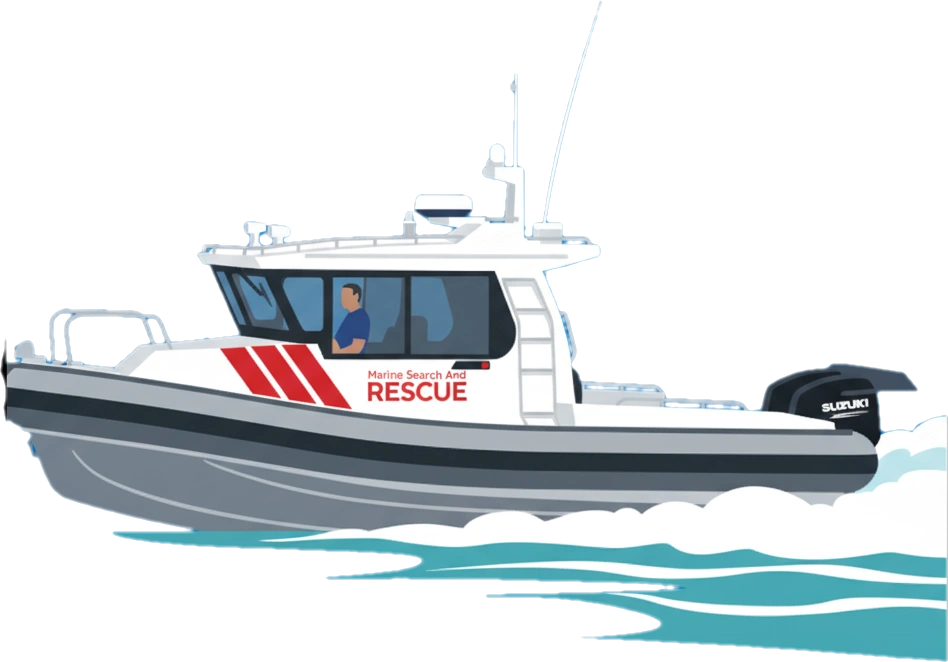
Crew / Deckhand
Base-level competencies required for all crew members assisting under direct supervision.
View Crew RequirementsCommand (Inland / PWC)
Requirements for commanding a vessel or PWC operating in inland (non-tidal) waters.
View Inland CommandCommand (To 3nm)
For commanding vessels under 12m operating up to 3nm from shore or in sheltered waters.
View Command (To 3nm)Command (Beyond 3nm)
For commanding vessels under 24m operating beyond 3nm from shore in specified areas.
View Command (>3nm)General Requirements (All Roles)
Under the AMSA EX24 Exemption, any person undertaking duties on an emergency service vessel must meet the following universal conditions:
- Be at least 16 years old.
- Meet the medical and eyesight requirements determined by the vessel operator (the MSAR unit).
- Disclose in writing any long-term or permanent medical condition that may affect their ability to perform their duties.
- Complete any ongoing training required by their specific MSAR unit to maintain competency.
Role: Crew / Deckhand Requirements
A person acting as crew or deckhand under the direct supervision of a master or engineer must hold the following:
- A current first aid certificate: HLTAID011 Provide first aid (or equivalent).
- Four core units from the MAR Maritime Training Package (or equivalent):
- MARF028: Follow work health and safety procedures
- MARF029: Meet work health and safety requirements
- MARF060: Survive at sea in the event of vessel abandonment
- MARN008: Apply general purpose hand skills aboard a vessel
- Completed a vessel-specific induction provided by the MSAR unit.
- Maintain a personal record of training if one is not maintained by the operator.
Role: Command of Vessel in Inland Waters or PWC
A person commanding a vessel or Personal Watercraft (PWC) in inland (non-tidal) waters must:
- Meet the recreational boating operator licensing requirements for the State or Territory of operation.
- Complete specific training on the vessel's operations, provided by the MSAR unit.
Role: Command To 3nm From Shore or in Sheltered Waters
A person commanding a vessel less than 12m long within 3nm of the coast or in sheltered waters must hold:
- A current first aid certificate: HLTAID011 Provide first aid (or equivalent).
- MAR Maritime Training Package Coxswain Grade 2 near coastal course (Certificate I level), or equivalent.
- A Short Range Operator Certificate of Proficiency (SROCP), or equivalent.
- Have completed training provided by the MSAR unit on setting up and securing a vessel towing operation.
- Maintain a personal record of training if one is not maintained by the operator.
Role: Command Beyond 3nm From Shore
A person commanding a vessel less than 24m long beyond 3nm must hold:
- A current first aid certificate: HLTAID011 Provide first aid (or equivalent).
- MAR Maritime Training Package Coxswain Grade 1 near coastal course (Certificate II level) or higher (e.g., Master up to 24m), including specific units for towing (MARB027) and outboard engines (MARF030) if applicable.
- An SROCP, or an LROCP if the vessel is fitted with HF radio.
- Completed training on coordinating search and rescue operations and vessel towing.
Note: From 1 July 2026, persons operating vessels between 12m and 24m must have completed the full Coxswain Grade 1 or Master <24m course and associated units (see Exemption for details).
Safety Management Systems (SMS) & Digital Logbooks
Under Australian National Law, every MSAR unit must implement and maintain a compliant Safety Management System (SMS). An SMS is a formal framework that ensures the safe operation of vessels, covering everything from operating procedures and crew training to vessel maintenance and emergency drills.
The Essential Tool for Compliance
A critical component of a compliant SMS is accurate and consistent record-keeping. To meet these legal requirements, a digital logbook is essential. We strongly recommend all volunteers use OffshoreSMS as their free personal digital logbook. It simplifies the process of logging trips, training hours, and incident participation, ensuring your records are always accurate and accessible.
Get Your Free OffshoreSMS Logbook